Showing posts with label Nirvana. Show all posts

Monday, December 30, 2013

MY 2013 YEAR END LIST

AROUND THE TRENDS

Ten things in music I liked about 2013


by Matt Ashare |  
Published December 31, 2013 http://www.newsadvance.com/the_burg/music/pop_rocks/


THE HOT SEAT: Lady Gaga delivered spectacle in 2013
Another year, another amorphous chorus of mixed messages about the so-called “state” of music, as if were actually possible to capture something so elusive in anything resembling its natural state. Back in March, David Lowery turned up on NPR’s “On the Media” to discuss some of the issues he addresses as part of “The Trichordist,” a website dedicated to “Artists for An Ethical and Sustainable Internet.” The erstwhile Virginia-based producer, longtime frontman of the bands Camper Van Beethoven and Cracker, and current a lecturer at the University of Georgia, suggested that the old business paradigm, dominated by monolithic major labels, really wasn’t all that bad, which is interesting coming from a guy who had his share of dust ups with the powers- that-be back in the day.
More recently, David Byrne, whose Luaka Bop label was once a part of Warner Bros., published “How Music Works,” a collection of essays in which he waxes somewhat nostalgic for the days when a corporate entity like Sire Records (which was also part of the Warner Group) would invest its resources in a left-of-center CBGB’s band like his own Talking Heads. In other words, now that these once-insurgent artists have gotten a look at the future of music, the past doesn’t look half bad.
         On the other hand, 2013 was also the year that Amanda Palmer celebrated her crowdfunding coup by delivering a TED Talk on the many virtues of tweeting, blogging, and otherwise interfacing directly with fans on the Internet. In 2012, she’d set a new record by raising over a million dollars in individual contributions on Kickstarter to record her second album, “Theatre Is Evil.” So, she’s understandably less concerned about the state of music than some of her peers.
Of course, when conversation turns to the state of music, what’s usually at issue is the state of the music industry, which has always been governed by rather arbitrary rules — copyright law, for example — that benefit some at the expense of others. There’s no doubt that technology — particularly in the digital realm — has been a game changer for the entertainment industry over the past decade, not to mention the last year. Whether or not it’s been a force for good or for evil remains up for debate. But, while the medium can be the message, more often than not technology, even in the face of cultural skirmishes, is essentially neutral: it’s really more a matter of how we choose to make use of evolving modes of consumption and communication that makes the biggest difference. By that measure, 2013 belongs to the comic Norwegian brother act Ylvis, whose surreal “The Fox (What Does the Fox Say?)” went mega-viral on YouTube and turned out to be this year’s “Gangnum Style.” I guess that means we should be on the lookout for a big ad featuring Vergard and Bård Ylvisåker shilling pistachios when Superbowl XVLIII takes to the air on February 2.
In the meantime, the proverbial beat goes on as artists continue to make music that weaves itself into the fabric of daily life in a manner that can be at once surprising and familiar; comforting and disruptive; ridiculous and sublime. It’s all good, even if not really all good. And, since there were far too many albums than I could justify paring down to a simple top ten, I’ve opted this year for a list of ten categories that feel like they capture something essential about the state of music in 2013. 

POP ART OR ARTPOP?: Arcade Fire can do both.  
1) ARTPOPPERY:  Arcade Fire “Reflektor” + Atoms for Peace “AMOK” —Lady Gaga, in her infinite ambition, may have twisted the Warholian idea of “Pop Art” into a multi-media marketing campaign that fuses the virtues of art with the baser nature of accessibility, but she’s not the first to play at that game (see David Bowie, below). And, while it may be more apt to place Arcade Fire’s expansive, retro-futuristic double concept album “Reflektor,” as well as Radiohead head Thom Yorke’s new Atoms for Peace missive “AMOK” in the category of what older folks once called prog- or art-rock, artpop seems a fair enough designation. Both bands flexed their considerable creative muscle and challenged loyal fans to accept a modicum of experimentation, while offering just enough in the way of infectious grooves and melodies to make the trip worth the effort. 
        
REBEL BELLE: Kacey Musgraves 
2) AMERICANA WITH ATTITUDE: Kacey Musgraves “Same Trailer, Different Park” + Natalie Maines “Mother” — Nashville’s Music Row has long been one of the most conservative corners of the mainstream music industry, which has admittedly bred quite a bit of vapid, predictable, middle-of-the-road product over the years. But it’s also fostered plenty of rebels and outlaws because, well, you gotta have rules before you can break them. Kacey Musgraves, a 25-year-old Texas-bred singer-songwriter who self-released three albums and appeared on the USA Network’s “Nashville Star” competition before signing to Mercury Records, may have rewritten the script for what’s acceptable on Music Row with “Same Trailer, Different Park,” a homespun yet crisply produced album of rather-trad tunes with more than a touch of twangy bluegrass that, among other transgressions, exclaims, “Make lots of noise/Kiss lots of boys/Or kiss lots of girls if that’s something you’re into,” and offers this vision of small-town life: “Mama’s hooked on Mary Kay/Brother’s hooked on Mary Jane/And Daddy’s hooked on Mary two doors down.” And Dixie Chick Natalie Maines moved away from straight country toward something more along the lines of Sheryl Crow’s rootsier side on “Mother,” an album of covers that delivers a devastating version of its Pink Floyd title cut that was originally recorded to raise money for the falsely imprisoned West Memphis Three.

RELATIVE COOL: The formidable sisters of Haim
3) GRRRL GROUPINGS: Haim “Days Are Gone” + Savages “Silence Yourself” — Trending retro in ways that were fashionably unfashionable in 2013, the California sister act Haim and the London-based grrrl group Savages drew on very different aspects of the ’80s on two of the year’s more promising debuts. With formidable musical chops, Haim fashioned their sly hooks around the funked-up rock of Prince’s Revolution and the kind smooth r&b grooves that Quincy Jones used to catapult Michael Jackson into the stratosphere, all without a trace of tongue-in-cheek irony. The aptly named Savages zeroed in on the post-punk nihilism of John Lydon’s Public Image Limited, the raw scrape of Joy Division, and the primal wail of Siouxsie and the Banshee, with a surplus of attitude and stark androgynous look to complete the package.

POP ART: David Bowie appropriates himself on The Next Day
4) HAPPY RETURNS: David Bowie “The Next Day” + Elvis Costello and the Roots “Wise Up Ghost” — One of the original purveyors of “artpop” and a major influence on Lady Gaga’s latest vocal affectations, David Bowie was apparently in a self-reflective state of mind when he set out to record his first solo album in a decade, and his 24th overall. With cover art copped from his own art-rock classic, 1977’s “Heroes,” and a single (“Where Are We Now?”) that sifts through images from his years in Berlin, “The Next Day” goes a long way toward recapturing past glories without necessarily repeating them. Bowie’s almost always interesting, but it’s been quite some time since he’s sounded this immersed in a musical project. And, what frankly seemed like something of a novelty collaboration between Elvis Costello and the Roots turned out to be a surprisingly solid collection of songs that deploy the hip-hop science of loops and sampling in a way that’s oddly reminiscent of Costello’s ambitiously orchestrated 1982 masterpiece “Imperial Bedroom.”

OLD SCHOOL RULES: Pearl Jam kicked out the analog jams
5) GUARDIANS OF GRUNGE: Dave Grohl’s “Sound City” + Pearl Jam “Lightning Bolt” —  An homage to the famed and now defunct studio where Nirvana recorded “Nevermind,” “Sound City” was both a loving documentary directed by Foo Fighter frontman/former Nirvana drummer Dave Grohl and a soundtrack featuring the Sound City Players, a remarkably diverse group of artists with various connections to the Northridge, CA studio. You get everyone from Stevie Nicks and Rick Springfield, to Queens of the Stone Age’s Josh Homme and Nine Inch Nails’ Trent Reznor, to Sir Paul McCartney backed by the three surviving members of Nirvana, all on an album of new material that serves as a visceral reminder that, on some level, they all share a certain common creative ground. As for Pearl Jam’s “Lightning Bolt” — their tenth studio album since 1991’s chartbusting “Ten” — it’s simply a straightforwardly stripped-down reminder that there’s still plenty of room for an unabashedly analog band in our brave new digital world.  

MOODY BLUES: The National embrace the darkness
6) INDIE ROCKS: The National “Trouble Will Find Me” + Superchunk “I Hate Music” — Nobody does nonchalantly dark, world-wearily romantic, or elegantly debauched quite as well as the Cincinnati-by-way-of-Brooklyn band the National. “Trouble Will Find Me,” an apt description of the persona Matt Berninger projects as the deep-voiced singer of the National, isn’t so much a departure for the band as it is a further distillation of the moody blues they revel in. There’s also some wistful romanticism on “I Hate Music,” the searingly melodic tenth album from North Carolina indie stalwarts Superchunk. You can’t blame singer/guitarist Mac McCaughan for screaming “I hate music” on the album’s title cut — as the founder of the longstanding indie label Merge Records, with bandmate and bassist Laura Balance, he’s probably been subjected to more than his fair share of noise. But, “I Hate Music” is, in its own peculiar way, a love letter to a DIY ethos that Superchunk helped create in the early ’90s.  

KANYE'S YEEZUS: No title required
7) DYSTOPIAN HIP-HOP: Kanye West “Yeezus” + Pusha T “My Name Is My Name” — Rappers aren’t just measured by their flow, their beats, or the number of units they’re able to move. It’s also about empire building, creating a brand bigger than one’s self, and moving the form forward in some notable way. Kanye (do we even need the West anymore?) has done all of the above. His “Yeezus” is one of the strangest hip-hop blockbusters in recent memory, with its maximal minimalist soundscapes, its fractured beats, and its often impenetrably dark sensibility. But that wasn’t all Kanye had cooking in 2013: having helped boost former Clipse member Pusha T’s status as a solo rapper through a guest spot on 2010’s “My Beautiful Dark Twisted Fantasy,” West stepped in as executive producer for T’s debut, “My Name Is My Name,” which along with “Yeezus” ranks as one of the more compelling and intriguing commercial hip-hop albums of the year.

THE REAL DEAL: 17-year-old Lorde 
8) THE YOUNG AND THE RESTLESS: Lorde “Pure Heroine” + Earl Sweatshirt “Doris” — As difficult as it may or may not be for new artists to find firm footing these days (as opposed to the good old days of major-label hegemony), there’s still plenty of evidence to suggest that just being really really crazy talented, inspired, and/or unique does have its advantages. Lorde is a wickedly precocious 17-year-old singer-songwriter from New Zealand, born Ella Marie Lani Yelich-O’Connor (thus the stage name), who has a remarkable gift for finding rough-hewn beauty in the mundane realities of daily life, and a strikingly confident voice that’s rarely accompanied by more than a sleek beat and a few backing racks on “Pure Heroine.” There are lots of singers sweating it out in an effort to capture the ’tweenage experience — I won’t mention names — but Lorde does it effortlessly, and with quite a bit more depth. An even odder oddball, 18-year-old Earl Sweatshirt emerged as a part of an LA indie hip-hop collective known as Odd Future Wolf Gang Kill Them All, released a mixtape filled with horrorcore fantasies in 2010, and then disappeared for a year, during which “Free Earl” t-shirts starting showing up in LA. His debut is a schizoid affair that, while reminiscent of the fantasy scenarios and just plain out-there soundscapes of the early Wu-Tang Clan, stands on its own as the next strangest thing to “Yeezus.”   


CROTCH SHOT: Miley Cyrus skews sexy
9) POP SPECTACLE: Miley Cyrus “Bangerz” + Lady Gaga “Artpop” — Not going to waste too much time here on the actual music, since both Miley and Gaga are more about making a scene or a splash than crafting a tune. And, Miley may have one-upped Gaga in 2013, with her white-girl twerks and that hilarious VMA stunt making nasty with a big Styrofoam finger (not to mention Robin Thicke). But Haus of Gaga has almost surely been hard at work, dreaming up something even bigger than the ArtRave extravaganza she staged to celebrate the arrival of “Artpop.” So there should be plenty more spectacle to feed on from both Miley and Gaga as we move on in to 2014.

10) BLASTS FROM THE PAST: Bob Dylan “Another Self Portrait” + The Clash “Sound System” — Yet another mysterious period of Dylan’s mysterious career has at least been partially unshrouded with the repackaged, remastered, and almost completely reconfigured “Another Self Portrait,” a two-disc set that draws on a pair of albums from 1970: “Self Portrait” and “New Morning.” If nothing else, it serves as a timely reminder that Dylan has always lived inside the Great American Songbook, that he’s always been an enigma, and that some of us will never tire of probing into the heart of Dylan’s darkness.  And then there are those of us who will forever wish that the Clash had stuck around for more than just the five albums they released from 1977-1982. The late great Joe Strummer’s main partner in crime, guitarist Mick Jones, has remastered all five discs for a ginormous set that also includes three discs of bonus rarities, a DVD or archival footage, reprints of a fanzine the band published, stickers, pins, buttons, and a set of Clash dogtags, all wrapped up in a package that looks like an old-school boombox. It’s one of the year’s best arguments in favor of the CD — streaming the audio just ain’t the same as owning the damn thing.     

Tuesday, February 21, 2012

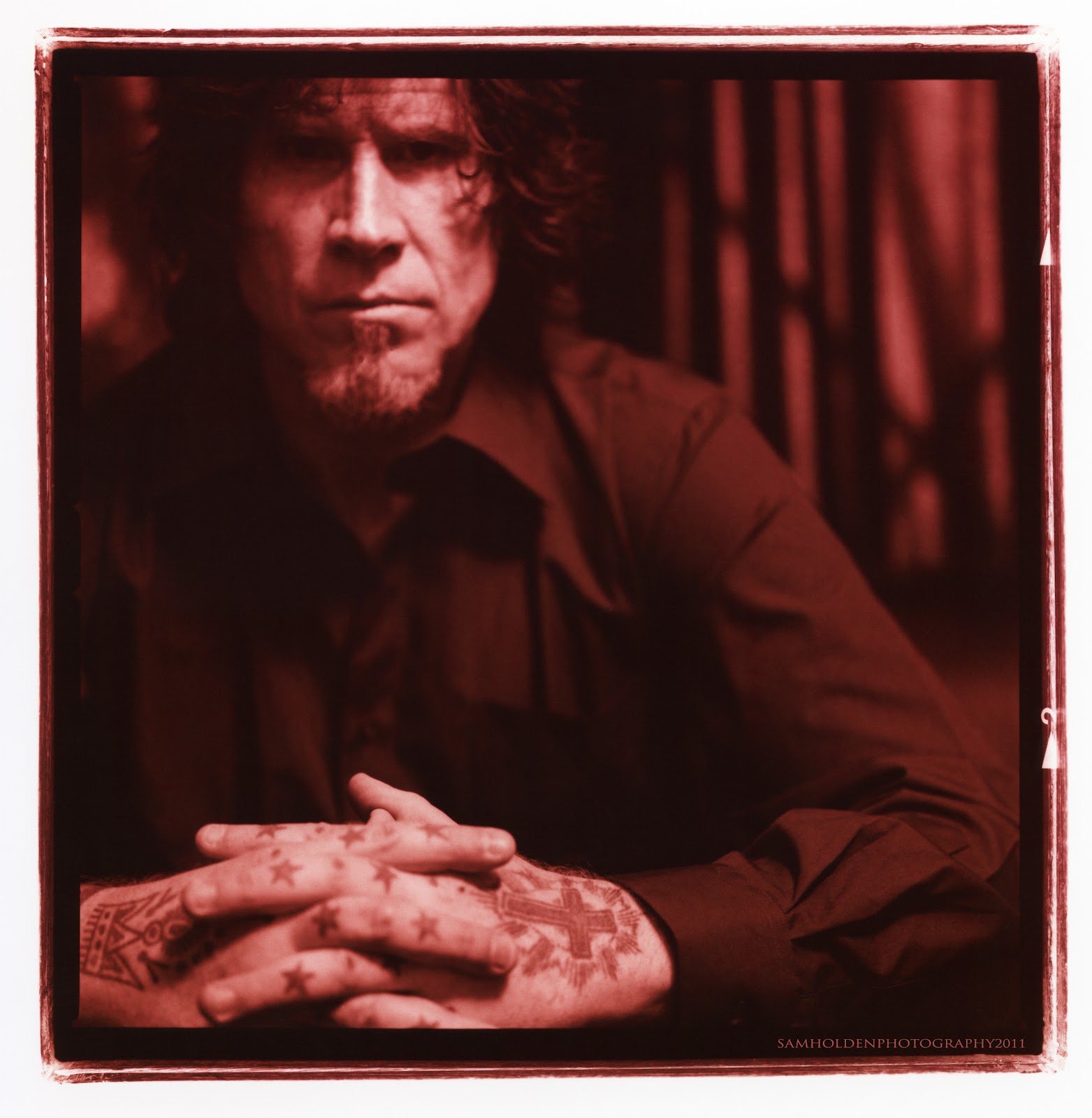
MARK LANEGAN


Mark Lanegan delves into a darkness beyond the blues

By Matt Ashare

Mark Lanegan Band, Blues Funeral (4AD)

DARK FORCE: Lanegan seduces with the force of a black hole
Mark Lanegan's voice is a deep, dark force of nature, more earthquake than hurricane, more thunder than lightening, more ominous than luminous. It's an instrument of blunt force that resonates with subtle aftershocks, rumbles portentously, and seduces with the irresistible force of a black hole. Lanegan's delivery has the power to imbue even the most playful nursery rhymes with sinister, apocalyptic undertones. He sounds like a guy who hasn't just seen into the abyss; he's looked it over, stared it down, and maybe even jumped right in.
       If there's a downside here, it's that Lanegan doesn't exactly have a lot of range, a failing that became apparent during the grunge heydays of the early ’90s, when the band he fronted, Screaming Trees, flirted with a kind of mainstream success. A product of the rural Northwest, the Trees had been toiling away as burly outsiders on the punk-oriented LA indie label SST for half a dozen years before they landed on Columbia at the height of the great surge of Seattle signings that hit in the wake of Nirvana's Nevermind breakthrough, and scored an alt-rock hit with "I Nearly Lost You," an emotionally wrought rocker that got a big boost from its inclusion on the soundtrack to the movie Singles. But the Trees simply weren't built for radio, alternative or otherwise. And, in 2000, Lanegan finally parted ways with the band to pursue a more modest solo career that he'd embarked on ten years earlier with The Winding Sheet, a spare, reflective, bluesy album that, among other highlights, featured Kurt Cobain singing and playing guitar on a cover of the very same Leadbelly classic Nirvana would later perform on their MTV "Unplugged" album, “Where Did You Sleep Last Night."
       As a solo artist, Lanegan seemed happy enough pursuing a kind of slow build toward something biblical, as his feet became more and more deeply entrenched in the fertile soil that lies at the crossroads where brooding rock meets deep blues. But Blues Funeral, his first solo disc since 2004's ironically titled Bubblegum, marks something of a great leap forward for Lanegan, both musically and moodfully. He's always done dark just about as well as anyone, with the kind of unimpeachable conviction you simply don't find with artists who only dress the part. But this time, you get the sense that he made a point of stepping outside of his comfort zone, of challenging himself to take that voice into alluring corners of the underworld he's never been entirely willing to explore on his own.
       Much of what makes Blues Funeral a creative breakthrough for Lanegan might be chalked up to the simple fact that he's been anything but idle since Bubblegum. By 2004, he'd already been an adjunct member of Josh Homme's Queens of the Stone Age for four years. And he continued lending vocal support to Queens’ albums up through 2007. In the meantime, he began collaborating with Scottish indie songstress Isobel Campbell of Belle & Sebastian on a series of more folk-based albums. In 2007, the British electronica group Soulsavers retained Lanegan as their primary vocalist, and the following year he and former Afghan Whigs frontman Greg Dulli released their first collaborative album as the Gutter Twins. Oh, and Lanegan also found his way onto a track by British producer Jamie LaVelle's forward-looking project UNKLE in 2010.
       Dulli and Homme are two of the more notable players Lanegan put together for Blues Funeral. They round out a cast that includes original Red Hot Chili Peppers drummer Jack Irons and his Eleven bandmate, multi-instrumentalist/producer Alain Johannes. Their impact is felt immediately, as grinding guitars and a muscular beat frame Lanegan's funereal allusions in the album's aggressive opening track, "The Gravedigger's Song." "In my blood flows sleep," Lanegan intones, "And the dark heavy rain/The magnolia bloom so sweet/Only torturing me."
       The blues are still a touchstone here, but the skeletal acoustic sketches that typified Lanegan's early solo recordings have been replaced by fully plugged-in arrangements. Even when he heads back to the delta to call out to the lord in "Bleeding Muddy Water," he's joined there by guitars that surge until they reach a symphonic peak as Lanegan repeats "You are the bullet/You are the gun" like an unholy prayer. It's the kind of haunted, gothic Americana that Gun Club specialized in and Nick Cave has often aspired to.
       Blues Funeral is shot through with dark visages, grim titles ("St. Louis Elegy" and "Deep Black Vanishing Train," to name two), guitars that rain heavily on leaden lyrics like "If tears were liquor/I'd have drunk myself sick," and thundering drums. But Lanegan and his posse use a lighter touch on "Gray to Black," the closest approximation to a pop song this singer's put his stamp on since "I Nearly Lost You." And a programmed beat paired with icy synths takes Lanegan somewhere within the general region of clubland on "Ode to Sad Disco," a mournful, six minute-plus elegy that incorporates some spooky, reverb-drenched slide guitar and finds Lanegan on his knees, contemplating "subterranean eyes," the "hollow-headed morning," and a "diamond headed serpent."
So, yeah, Lanegan can be a little heavy handed with the gloom and the doom from time to time. But it never feels overly theatrical in the black-lipstick-and-mascara vein. It’s just what’s bred in his bones. And he’s also just plain good at it. 

Wednesday, February 8, 2012

THE GRAMMYS

Adele, Bon Iver, and Jay-Z Get Their Night at the Grammys
by Matt Ashare The Burg, February 8
Can Justin Vernon as Bon Iver be this year's Arcade Fire?
Once upon a time, there may have actually been a certain logic to the Grammys. Back when the record business was fairly well centralized, radio was the dominant medium for song consumption, and a defined notion of what constituted the pop mainstream existed, it presented an opportunity for the organization that runs the awards — the National Academy of Recording Arts and Sciences (NARAS) — to put its best face, or faces, forward. And, as with the Oscars, there was a measure of predictability when it came to who got the big nominations. But those days are long past. And nothing in recent memory illustrated that more vividly than the closing moments of last year's 53rd annual Grammy Awards show, when an unconventional indie-rock band from Toronto, the Arcade Fire, beat out multi-platinum rapper Eminem, pop princess Katy Perry, and a pair of Ladies — Antebellum and Gaga — for Album of the Year, on a night when tween sensation Justin Bieber was mercifully upset by jazz artist Esperanza Spalding in the Best New Artist category.
         So, yes, in spite of expected multiple wins by marquee stars (Eminem, Jay-Z, John Legend, and the above mentioned Ladies), as well as a few respectful nods in the direction of legacy artists (Paul McCartney and Neil Young), it was something of a watershed moment for an institution that hasn't always had a particularly good reputation for keeping up with the times. After all, the Grammys were famously slow on the uptake with hip-hop. And NARAS has endured some rather shameful moments in the past couple decades: a depleted Jethro Tull beating out Metallica for Best Hard Rock/Metal honors in 1989; Nirvana's "Smells Like Teen Spirit" losing to professor Eric Clapton's MTV unplugged recording of "Layla" for Best Rock Song in ‘92; and Steely Dan's Two Against Nature prevailing over Radiohead's OK Computer and Eminem's admittedly controversial The Marshall Mathers LP in 2000.
         All of which has made handicapping the 54th Grammys, which air this Sunday night on CBS, something of a crap shoot. Will the Arcade Fire win of 2011 truly mark the start of a trend? Or will NARAS voters, cowed by angry Bieberheads, take a more measured, conservative approach when they cast their ballots? On the surface, at least, the list of nominees suggests it could go either way.
         Not surprisingly, rap superstar Kanye West goes into the night as an odds-on favorite with seven nominations. Then again, Eminem had a full ten last year, and only walked away with two. It should also be noted, with appropriate bemusement, that Kanye's in the paradoxical position of being up against himself for Best Rap Album, with his My Beautiful Dark Twisted Fantasy sparring with his Jay-Z collab Watch the Throne for Rap Album of the Year. (Unless I've got the math wrong, that means the most he can win is six.) Of course, Kanye's got a bit of a checkered past when it comes to awards shows (see: Taylor Swift), and, for all of his obvious talent and industry power, he is not quite the kind of role model NARAS tends to prefer. So don't be surprised if, like Eminem, he only comes away with a pair of victories.
         If there is anything close to a sure bet this year, it's gotta be British soulstress Adele, a critic's darling with a clean record, six nominations, and the right profile to be a Grammy poster girl. Her 21 may very well leave Lady Gaga high and dry in the Album of the Year category for the second year running. But thanks to some major changes in some major categories, Adele's going to face stiff competition not just from Lady Gaga, but also from seasoned songwriter-turned-pop star Bruno Mars in a category like Best Pop Solo Performance because this year NARAS has done away with separate slates for male and female artists. And Mars, along with the alt-rocking Foo Fighters, also has six nominations.
         But the most intriguing prospect for the kind shock and awe the Arcade Fire brought to last year's show comes by way of another indie upstart, the artist known as Bon Iver (a/k/a Justin Vernon). Vernon is in the running for four Grammys — Best Song, Best Record, Best New Artist, and Best Alternative Album. It's a long shot, but if Adele and Mars split the pop vote for Best Song, Bon Iver's "Holocene" could come out on top. And since Vernon wrote "Holocene" himself, the same could happen in the Best Record category. He's got the curvaceous Nicki Minaj to contend with if he's to take Best New Artist. And he's up against Radiohead's King of Limbs for Best Alternative Album, although Radiohead have got other opportunities (Best Rock Performance and Best Rock Song).
         Which leads me to some of the more perplexing aspects of this year's Grammy nominations — yes, more perplexing than the distinction between Best Record and Best Album. What makes Radiohead more "alternative" than Wilco, whose The Whole Love is stuck in Best Rock Album with Jeff Beck's Rock 'n' Roll Party Honoring Les Paul (seriously?), as well as discs by Foo Fighters and the Red Hot Chili Peppers? If Beck's disc wins that one, it may amount to another Jethro Tull oops. It's also unfortunate that the Black Keys, who released the best album of their career last year, have to compete with a collaboration between the legendary Tony Bennett and the late Amy Winehouse in Best Pop Duo/Performance. I mean, really, do the Black Keys as a pop duo? And, while I had been hoping that the Decemberists might enjoy a much deserved Arcade Fire moment this year, that's just not the way it's looking to pan out. They got some props — Best Rock Performance and Best Rock Song for "Down By the Water." And maybe they'll best Coldplay, Foo Fighters, and Radiohead in one of the two. But, as Sunday approaches, I beginning to think NARAS could do worse than asking the Arcade Fire back for a reprise of last year's closing credits.

Wednesday, September 7, 2011

STEPHEN MALKMUS

Stephen Malkmus gets a little help from friend Beck on 'Mirror Traffic'


Nirvana were far from the only paramount band to come out of the ‘’90s underground.
In fact, surveying the current rock landscape, where an off-kilter Toronto band like Arcade Fire can win top honors at the Grammys and Portland’s brainy little band the Decemberists can debut at No. 1 on the "Billboard" charts, one could easily credit the lesser known but no less influential California-by-way-of-NYC band Pavement for having a bigger impact than even Nirvana on today’s odd state of the musical arts.
8-31 Stephen Malkmus
Stephen Malkmus and the Jicks
     Indeed, if the band’s lanky, unapologetically cryptic, often willfully obscure slacker of a frontman Stephen Malkmus didn’t exactly invent the idea of indie-rock as the smart-guy wing of the alternative nation, he certainly did more than anyone else to popularize the notion.
Malkmus, a UVa grad who led Pavement through five acclaimed albums from ’92 to ’99 before packing it in and moving to Portland, Ore., has quietly been recording and performing a raucous, jammy, guitar-centric brand of grown-up indie-rock with his band the Jicks since 2001.
      But, the singer/songwriter/guitarist’s solo work has largely been overshadowed by deluxe reissues of the Pavement catalogue and last year’s Pavement reunion tour. Chalk that up to Malkmus’ preferred method of songwriting — contorting a riff borrowed from a random tune, improvising lyrics on the spot, and delivering them with little concern for things like, oh, staying on pitch. Even back in the Pavement days he came within spitting distance of "radio-friendly" with only a handful of tracks: the chaotic yet melodic "Cut Your Hair" would be one, and the more laid-back, country-tinged "Range Life" would be, well, the other.
     Nevertheless, something clearly clicked when Malkmus, keyboardist Mike Clark, bassist Joanna Bolme, and former Sleater-Kinney/Quasi drummer Janet Weiss (who’s since been replaced by Jake Morris) entered the studio with Beck to record the new "Mirror Traffic."
Maybe it was Beck’s presence: of late he’s distinguished himself as a remarkably tasteful producer on albums by Marianne Faithfull and Charlotte Gainsbourg. Or perhaps the prospect of the Pavement reunion, which took place after "Mirror Traffic" was completed, simply put Malkmus in a more focused frame of mind. Either way, even Malkmus, in a recent press release, concedes with characteristic understatement, "this record is relatively approachable."
     Despite the rather formidable amount of ink that’s been spilled puzzling over Malkmus’ lyrics, he’s always been as much a guitar wonk as a wordsmith, a tendency that only became more pronounced when he started producing his recordings with the Jicks.
You can hear echoes of that on the new "Brain Gallop," a bluesy number rife with string-bending leads. But it’s one of only three of the 15 tracks here that surpasses the five-minute mark. And that’s a positive development.
     Beck’s never struck me as a particularly strong taskmaster, but it sure sounds as if someone inspired Malkmus to rein in his more avant inclinations and, instead, tap into his knack for marrying an inviting melody to intriguing/amusing free-form lyrics. "I caught you streaking in your Birkenstocks/A scary thought in the 2Ks," he sings on "Tigers," the disc’s hooky opening track, "Got enveloped in your sticker shock/I gotta tell you it’s a barrage/it’s a barrage/It’s a mirage." It sets the tone for what might be the first Malkmus album that won’t have casual fans skipping occasional bursts of noisy discord.
     Okay, "Mirror Traffic" does go out on an experimental limb on the ambient instrumental "Jumblegloss." But the track is a merciful minute and 13 seconds long. More typical are fully realized songs like the intimate, acoustic rumination "No One Is (As I Are Be)," where Malkmus hums along with a nice little trumpet solo, and the harder-rocking "Senator." The latter, with its references to American-made toxins, a cattle-prodded working class, and the illicit behavior of an unnamed elected official, is the most overtly political sing-along in the Malkmus canon.
     So, no, it wouldn’t be quite right to conclude that Malkmus has lost his edge, just as it would be a mistake to think that he’ll ever be an irony-free straight shooter. This isn’t so much a case of an old dog learning new tricks as him opting, at least for now, not to play quite so many cat-and-mouse games with his fans.

Thursday, March 31, 2011

Honestly, I try to be nice. . .

Music review: The Strokes try to find their way back

By The Burg Staff on Mar. 30, 2011
BY MATT ASHARE
To alter a quip from Ben Franklin, in this world nothing can be certain but death, taxes, and the inevitability that rock music will from time to time circle back to find renewal in the past.
In the fall of 1991, it was Nirvana who exploded convention by restating the suburban teen angst of punk in terms that captured something essential about the alienation of the times, ushering in the rebirth of a certain brand of aggressive “guitar rock.“
Ten years later, in the fall of 2001, the out-of-nowhere emergence of an odd little band from New York City — the Strokes — heralded the re-emergence of another particular brand of retro guitar rock that, ah, captured something essential about the alienation of the times ... or something like that.
     If Nirvana got their point across with bolded, arena-sized hooks and confessional, if often oblique lyrics, then the Strokes delivered their message in italics, with slanted melodies and the enchanting vocals of Julian Casablancas, a master of debauched elegance with a gift for singing in subtext.
     Spurred on by early British hype that proclaimed the NYC fivesome rightful heirs to the downtown cool of the Velvet Underground and “Walk on the Wild Side” Lou Reed, the Strokes employed a scaled-down, underproduced aesthetic that created the impression they’d arisen fully formed from the garage — or, in this case, a cramped Lower East Side rehearsal — on their RCA debut, “Is This It” (no question mark needed).
     Unlike Cobain, who came out of nowheresville with the flannel shirts to prove it and a giant chip on his shoulder, the Strokes were privileged prep-school kids slumming it in second-hand-store black with affected yet intense nonchalance that was intoxicating. I mean, there’s just something so blithely charming about the way Casablancas slurs his way through “Last Nite,“ one of several stand-outs on “Is This It,“ and a song that, amid insistent, even upbeat guitars, essentially can’t be bothered to care about a girlfriend who feels “so let down” and “so left out.“
     A lot has happened to the Strokes in the past decade, most of it not so great. Following up “Is This It” was indeed a tall order, but bleeding the seedy out of the cleaned-up 2003 disc “Room On Fire” and 2006’s even cleaner “First Impressions of Earth” was just a bad move.
In the wake of declining record sales, the band opted for a “much needed break,“ which left rhythm guitarist Albert Hammond Jr. free to pursue his own pop pursuits on two adequate solo albums and led Casablancas to explore the dance floor in his own wry manner on 2009’s “Phrazes For the Young.“ Still, I was hopeful when I heard that the Strokes had regrouped to record their fourth album. One can always hope. . .
    It’s not that there’s nothing to admire about the new “Angles.“ For one, Nick Valensi has developed into a formidable lead guitarist. And the band locks into the same propulsive groove on “Under Cover of Darkness” that drove “Last Nite” home, even if it’s a kinder Casablancas who earnestly croons “I’m tired of all your friends listening at your door/And I want, what’s better for you.“ (On “Last Nite” he at least sounded tired.) When synths mix with guitars on “Two Kinds of Happiness,“ Casablancas affects an arch deadpan that brings to mind the Cars. And then Valensi steps all over the song with far too much noodling, as he does way too often on “Angles.“
     In the end, I found myself humming “Last Nite,“ which is just another way of saying thanks to the Strokes for reminding me to go back and spend some quality time with “Is This It.“
Ashare is a freelance writer based in Lynchburg and former music editor for The Boston Phoenix. http://www.the-burg.com/blogit/entry/music_review_the_strokes_try_to_find_their_way_back http://www.bostonphoenix.com/boston/music/other_stories/documents/04726984.asp