Wednesday, March 14, 2012

BRUCE SPRINGSTEEN


The Boss gets back to work

By: MATT ASHARE |

Bruce Springsteen, Wrecking Ball (Columbia)

WORKING IT: Springsteen take up the populist cause once again
It's not easy being Bruce Springsteen. Sure, by almost any measure, he's one of the most massively and persistently successful musicians of our time, a bona fide household name who can count himself as one of the few performers capable of filling stadiums. He’s got an enviable legacy that's afforded him the artistic license to do more or less as he pleases, from chasing the ghost of Steinbeck's Tom Joad, as he did on a critically acclaimed 1995 solo album, to celebrating the legacy of folksinger Pete Seeger, a project he undertook in 2006. Those are just a few of the perks that come with being The Boss.
       And yet, Springsteen has toiled diligently to retain his status as a working man's rock star — a populist progressive in standard-cut Levi's with an abiding respect for our servicemen, our service sector, and the regular folks who make the factories run. He's a prophet of the crumbling American dream, a true believer in the humble virtues of a job well done and the value of a hard day's labor, even if his portfolio probably looks more like Mitt Romney's than Joe the Plumber's.
       Springsteen cannily addressed this conundrum early in his career by treating rock stardom as something akin to a blue-collar job, sweating his way through epic performances until his buddies in the E Street Band would literally have to pick him up off the stage for a final encore. Then, with 1982’s pared-down Nebraska, he stumbled upon strategy for longevity that has allowed him to remain true to his populist ethos without forsaking his stake in anthemic, E Street theatrics. He’s kept critics happy by revisiting the anguished Americana of Nebraska on The Ghost of Tom Joad and Devils & Dust, while reuniting regularly with the E Street crew to please his core constituency, as he has once again with the new Wrecking Ball.
       To his credit, Springsteen's never articulated a clear line between stardom and social activism. But that has created problems, most notably when Ronald Reagan co-opted "Born In the U.S.A.," a damning fist-pumping anthem that details the dismal plight of Vietnam War vets, for stump speeches without fully vetting the lyrics.
       That episode may have given Springsteen pause; for a time, at least, he seemed somewhat gun shy when it came to bringing politics to the E Street party. But a righteous anger has been simmering in Springsteen’s heart. And he comes out shooting from the hip on Wrecking Ball, an album that takes aim at Wall Street “fat cats,” predatory bankers, and modern-day “robber barons.”
       There’s more to Wrecking Ball than just calling out bad guys. As was the case on “Born In the U.S.A.” — the song and the album — Springsteen is walking a fine line here between a kind of stoic patriotism and gut feeling that things just ain’t right. That’s where it all gets a bit tricky. Against an imposing wall of thundering drums, massing guitars, surging synths, Springsteen takes stock of “hearts turned to stone full of good intentions,” while wearily celebrating the solidarity of the American people on the disc’s first single, “We Take Care of Our Own.” The song also cops a line from “America the Beautiful” and finds Bruce waving the flag “from Chicago to New Orleans/From the muscle to the bone/From the shotgun shack to the Superdome,” until it’s not entirely clear where he’s headed, except, perhaps, to the Superdome for a big gig.
       Not that there’s anything wrong with that. It’s just that, unless you listen super carefully to the lyrics, the song has a rather jingoistic veneer. Add to that the super big-budget studio production and, well, let’s just say that one could very easily imagine a triumphant Mitt Romney bounding to the stage to accept the Republican nomination to a bombastic tune like this.
       Subtlety has never been an E Street staple. Heavy handed is their dominant mode. That’s just fine for the stadium rockers here. But it gets a little weird when they crash in on a rootsier number like “Easy Money,” a tune that begins as an acoustic foot-stomper before the band amp it up to something resembling a hi-tech hoedown. And there’s something a little off about the gloss they apply to the grit of “Shackled and Drawn,” an ode to the old world virtues of a sweaty shirt and a hard day’s work filled with lots of whooping, hollering, and an oddly synthetic sounding fiddle. “Up on banker’s hill the party’s going strong,” Springsteen growls, “Down here below we’re shackled and drawn.”
       Songs are fictions set to music. And it’s every singer’s prerogative to inhabit any character he or she chooses. Indeed, from the freewheeling desperado in “Born to Run” to the conflicted cop in the Nebraska tune “Highway Patrolman,” Springsteen’s has had a great track record when it comes to bringing such fictions to life. But on Wrecking Ball he overreaches. He may empathize or even identify with the downtrodden denizens of “Shackled and Drawn.” But, let’s face it: even if he’s not part of the “party,” these days he lives a lot closer to “banker’s hill” than a “shotgun shack.”
       That’s not to suggest that Springsteen’s disingenuous, only that he’s not as believable playing the role of the workingman as he once was. And, he needn’t force it. On “Jack of All Trades,” a stolid ballad built around lovely piano arpeggios and anchored by mournful organ tones, he delivers a moving meditation on the state of the world (“The banker man grows fat/The working man grows thin/It’s all happened before/And it’ll happen again”) from his own perspective, and it works.
       In fact, Springsteen’s at his best here when he gets personal. “This is my confession/I need your heart in this depression,” he sings tenderly in the halting “This Depression.” It’s a simple sentiment that gives way to a searing guitar solo that just feels right. Similarly, “You’ve Got It,” another track that steers clear of redressing grievances, captures Springsteen at his most affecting, soulfully serenading a lover as he contemplates his own mortality.
       Mostly, though, Wrecking Ball is about weathering through hard times, finding redemption in the process, and maybe even getting a little taste of transcendence in the end. Springsteen does he best to squeeze all of that into the 7-minute epic “Land of Hope and Dreams,” a huge production that echoes “Born to Run” and then moves beyond it, with a full gospel choir, looped beats, banjo, and a Sam Cooke sample joining an uplifting solo by late E Street Band sax player Clarence Clemons. Springsteen even manages to squeeze in a Civil Rights-era Curtis Mayfield allusion as he breathlessly races toward the finish line.
No, it’s not easy being Bruce. But maybe it doesn’t have to be as hard as he makes it sound on Wrecking Ball.

Wednesday, March 7, 2012

COWBOY JUNKIES


Cowboy Junkies take the long way home to their folky comfort zone


Who: Cowboy Junkies
When: March 3, 7 p.m.
Where: The Jefferson Theater, 110 East Main St., Charlottesville
Tickets: $35 in advance, $37 at the door

FOUR x FOUR : Cowboy Junkies are touring on not one but 4 new CDs
The typical routine for a successful songwriter has, for decades, looked something like this: Spend about a year writing a dozen or so tunes; record the pick of the litter with or without accompaniment; release them on an album; and then, if all goes well, head out on the road to promote the new material. Lather. Rinse. Repeat. . .
       It's really not bad work if you can get it. And Michael Timmins, resident songwriter/guitarist in the Toronto-based folk-rock group Cowboy Junkies, had been getting it for a solid two decades before hit something of a wall in 2008. In league with his sister Margo (vocals), his brother Peter (drums), and bassist Alan Anton, he'd delivered a dozen albums in just over 20 years when, as he explained over the phone from Toronto just a few weeks before embarking on tour that brings them to the Jefferson in Charlottesville on March 3, he just didn't feel ready to jump back in.
       "I started working on songs for a new album," he recalls, "just going through the cycle where you write, put out a record, record it, and then you have to live with it for two years. We were also in the middle of touring, and I just wasn't hearing an album there. It wasn't so much the songs as it was my feelings about having to do the whole cycle again. I just wasn't ready, so I was having trouble of getting into the right headspace."
       Fate intervened: Timmins, who'd adopted two Chinese orphans with his wife, found himself jolted out of the bandlife, living in a small town outside of Shanghai for three months. "My wife was offered a job teaching English over there," he says. "And we thought it would be a great opportunity for our kids to go back and emmerse themselves in the culture."
       Timmins also experienced a cultural emersion of sorts; he returned to Toronto, and to Cowboy Junkies reinvigorated as a songwriter and determined to incorporate the sounds of the Far East into his own music. The result wasn't just one new album, but a collection of four diverging discs released as "The Nomad Series" over the course of 18 months, culminating recently with the release of The Wilderness, a spare and wistful album that features half a dozen of the tunes Timmins started writing before the China trip.
       With its gently restrained arrangements, contemplative tone, and an organic feel that places Margo's nuanced vocals front and center, The Wilderness is the one that sounds, well, pretty much the way you'd expect a Cowboy Junkies album to sound. In contrast, Remnin Park, the first in the series, is the quirkiest, blending samples of music and chatter from the streets of China into country-tinged acoustic ballads, electric rockers, and even a tasteful little electronica excursion. The band dedicated the second "Nomad" recording, Demons, to covering the late Vic Chesnutt, re-imagining the Georgia-bred singer's often skeletal songs with bold guitar riffs, muscular backbeats, a heap of Highway 61 Revisited organ embellishments, and, of course, Margo's sultry yet stern voice. And on the series' third disc, Sing In My Meadows, the Brothers Timmins are fully plugged in, as they rock their way through 8 extended blue-based jams outfitted with serrated slide guitars, crashing cymbals, and plenty of extended soloing.
       It's a lot of music to take in, and a lot of songs to sort through as the band prepare to hit the road. But Timmins isn't worried. Here's more of what he had to say about genesis of "The Nomad Series," the impact of his China trip, and the general state of Cowboy Junkies affairs. . .

Q: I get that your time in China inspired you to take your songwriting in a new direction, but how did that lead to a series of albums that are so very different, and that essentially took right back to where you began in 2009?
       When I went off to China, my whole perspective changed. I had all this music from China and I just felt that it had to influence the next thing we did. I couldn't just ignore it. So that's really when we began to think in terms of how do we do this? There was lots of stuff happening, and we just had to figure out how to incorporate all of that into an album project. The Wilderness songs just weren't feeling right to me at the time. There was just too much other input coming in. So we came up with the idea of the "Nomad" project. We started with an album based on my China experiences. That allowed me to put the songs I'd been working on for The Wilderness away for a almost two years. After that, I was able to hear them with fresh ears, and get more of a direction for them. And, also, with the four albums, it just made sense to me that this was going to be an album about the songs — about songwriting and about singing. It's more folk driven, and it's more of a nod to our older style, which is fine in the context of four albums. Now I like The Wilderness. But first, there were other things we wanted to express and get out musically as a band. 

Q: I know you were close with Vic Chesnutt and had even collaborated with him, but was Demons a way for you to take a break from songwriting?
       Maybe a little bit. The other aspect of it is that we've done a ton of covers. And our best known song, "Sweet Jane," is a cover. We're kind of known for that — taking songs and transforming them into something different and that's ours. We don't play them note-for-note. We try to get inside them and turn them around and figure out how to do the song in our own style. It was the same with Vic's songs. It just made sense for us to play into the side of the band that is about doing cover songs. We knew we were taking on something that could blow up in our faces. But it was a really good challenge, and we thought that if we could pull it off it might bring more people to Vic's stuff, which was a big part of it too.

Q: Sing In My Meadows sounds like something you and your brother — and Alan — just needed to get out of your system. Am I right?
       That was the intention. There's an aspect to our live performances that is encompassed in that record. As you were saying, when people hear our name, most of them probably think of an album like The Wilderness. And live, we certainly have that vibe — that spacey or spacious vibe. But, over the years, we've also developed more of an acid-blues or psychedelic side, where we'll we'll take off on certain tangents and do a lot of jamming and get a bit noisy. That's where the musicians get a chance to get their ya-yas out. With the "Nomad Series," we finally had an opportunity to really focus on that side of the band's personality. In the past, we might include a couple of songs like that on an album, but never for an entire album.

Q: So how are you planning to do all of this live?
       When we toured Europe in November, we experimented with how to present it, because there is so much new material and we also want to play catalog stuff as well, not just for ourselves, but for the audience especially. So we've been doing two hour-long sets. The first is all "Nomad" material. And then we do a second set of all catalog stuff. Margo announces up front that that's what we're doing, so people can focus on the newer material without hearing songs from twenty years ago. And they're not listening to the new songs hoping that the next one is going to be one of their old favorites.

Q: Things don't always go all that well when siblings play music together. I'm thinking of the Everly Brothers, the Kinks, CCR, Dire Straits, Oasis. What's Cowboy Junkies secret for keeping the peace?
       I don't know: Good parenting, I guess. It's all just speculation. Maybe one difference is that there's a sister in there. There are six kids in the family, and Margo's role has always been that of the mediator. That's maybe part of her role in the band as well. But I guess I can't really tell you why it works.

Thursday, March 1, 2012

NEW MULTITUDES


Jay Farrar, Jim James, Anders Parker, and Will Johnson celebrate Woody Guthrie’s centennial


New Multitudes, New Multitudes (Rounder)

ALT-COUNTRY ALL-STARS
It’s hard to imagine that Son Volt singer/guitarist Jay Farrar and My Morning Jacket frontman Jim James (a/k/a Yim Yames) weren’t at least thinking about the current state of affairs in this country when they were invited, along with Anders Parker (Varnaline) and Will Johnson (Centro-matic), to cull through the vast archive of unpublished Woody Guthrie lyrics by his daughter Nora. The idea was for the four alt-country fellow travelers to join forces on an album that would bring those lyrics to musical life to mark the centennial celebration of Woody’s birth year.
         That year has come. And the album, New Multitudes, has arrived with fairly minimal hype at a time when Occupy Wall Street is still going strong, during a week that began with seemingly tone-deaf Republican presidential hopeful making news with a rather bone-headed remark at the Daytona 500. In case you haven’t heard, when asked if he followed auto racing, Mitt Romney responded, “Not as closely as some of the most ardent fans. But I have some great friends that are NASCAR team owners.” Maybe he was just kidding. But given the size of his bank account, not to mention his Super PAC, it’s not all that funny.
         So whether or not Farrar, James, Parker, and Johnson, who are touring under the moniker New Multitudes, meant to drop a populist smartbomb in the midst of a our on-going recession and one of the nastiest political climates in recent memory, they’ve succeeded. Because, while the real Woody Guthrie was a complicated artist who wrote all kinds of songs, the mythical Woody Guthrie lives on as the activist Dust Bowl Troubadour who penned “This Land Is Our Land,” scrawled “This machine kills fascists” on his guitar, and, in contemporary parlance, trumpeted the cause of the 99%.
         Farrar and his crew aren’t the first songwriters to be given access to the Guthrie archives. Jeff Tweedy, Farrar’s former bandmate in Uncle Tupelo, and his band Wilco, joined forces with British punk-folkster Billy Bragg on two albums that set unpublished Guthrie lyrics to music, 1998’s Mermaid Avenue and 2000’s Mermaid Avenue Vol. II. And Guthrie’s been a major influence on socially conscious artist since Bob Dylan first coopted the Dust Bowl Troubadour mantle back in his freewheeling folk days. Clash rabble-rouser Joe Strummer originally dubbed himself Woody Mellor in Guthrie’s honor. And Bruce Springsteen, an avowed Guthrie acolyte, has been known to pull out “This Land Is Your Land” from time to time, most memorably on his album Live 1975-1985.
         But New Multitudes, through no fault of their own, have arrived at a time when simply invoking the legacy of Woody Guthrie carries a moral weight that would be difficult to quantify. To their credit, though, they don’t get mired in anything too heavy handedly dogmatic or overtly preachy. Farrar kicks off the album with the meditative “Hoping Machine,” a slow building rocker he delivers with characteristic world-weariness as he winds his way through lyrics like “Word is the music and the people are the song” until his fellow singers join in on the open-ended punch line “Out of order,” a sentiment that could apply to just about anything in the broken-down world the song inhabits.
         Elsewhere, Parker, who played with Farrar in the band Gob Iron, takes the lead on the acoustic “Fly High,” a straightforwardly folky, poetic rumination on a troubled romance sung from the window seat of cross-country flight. And, Johnson is at the helm for the album’s hardest hitting number, the unmistakably Springsteen-styled “V.D. City,” a place populated by skid row denizens where “nobody knows you by name,” harmonicas blare, and overdriven guitars tangle a friendly fight to an anthemic finish.
It’s James who tackles what might be the album’s most outwardly partisan tune, the spare, fragile, and bluesy “My Revolutionary Mind,” a forlorn love ballad or sorts that culminates around a gently sung, if somewhat bemusing chorus: “I need a progressive woman/I need an awfully liberal woman/I need a socially conscious woman/To ease my revolutionary mind.” And Farrar manages with relative ease to invest the disc’s simple title track with a solemnity of a secular prayer. Against a backdrop of strummed acoustic guitars, he intones “Gonna win my battle for peace,” “Gonna build my world over,” “Gonna build my world with love,” turning what sound like scribbled thoughts into a coherent and powerful statement of purpose.
That said, the real strength of New Multitudes is the balance Farrar, James, Parker, and Johnson bring to the project, both in terms of the music they’ve set Guthrie’s words to, and the glimpses we’re given into Guthrie’s world. There are deep thoughts, dark images, and serious moments here. But there are also bright spots like R.E.M.-ish jangle of “Old L.A.,” an ode to an oft maligned city sung by Parker in a manner that brings to mind Michael Stipe. And just having the opportunity to hear Farrar and James spar on guitar should be enough to bring a smile to the face of contemporary Americana fans.
It’s hard to know exactly what Farrar, James, Parker, and Johnson went digging for when Guthrie’s notebooks were open to them. But they appear to have found it.      

LAMBCHOP


Kurt Wagner’s moving meditation on the late Vic Chesnutt


Lambchop, Mr. M (Merge)

It had to be fairly early in the ’90s — definitely no later than 1995. I was in Manhattan for a music convention and I wandered mid-day from my Midtown hotel to a mid-sized theater space at Lincoln Center just in time to grab a seat before Kris Kristofferson, the outlaw country star-turned-Hollywood actor, walked on stage as the main attraction for one of those songwriters' workshops where four or five artists play a tune or two and then talk about their process, dropping enlightening and/or amusing anecdotes along the way. I don't remember much who else was on that stage or about what transpired, although I'm pretty sure Kristofferson, tall and ruggedly regal in cowboy boots and jeans, may or may not have done "Me and Bobby McGee," the song for which I knew him best. But I wasn't there for that. I was much more interested in a lesser-known singer-songwriter on the bill, a guy in a wheelchair who called himself Vic Chesnutt.
       Chesnutt, the victim of a car accident in his late teens, was an outsider's outsider artist who'd been "discovered" by Michael Stipe playing around Athens, GA, in the late ’80s. The R.E.M. frontman would go on to produce Chesnutt's first two remarkable albums, 1990's Little and the one that initially caught my ear, ’91's West of Rome. Seven years later, R.E.M. joined the likes of Smashing Pumpkins, Indigo Girls, and, yes, Madonna covering Chesnutt's songs on the benefit album Sweet Relief II: The Gravity of the Situation. But what I remember best about that day at Lincoln Center was both how shabby and diminutive Chesnutt looked next to the imposing Kristofferson, and how genuinely moved — "blown away" is probably more accurate — Kristofferson seemed as Chesnutt strummed his way through the mini-set.      
       On his best days, Vic could do that. On his worst, he wrestled with the demons that were muses of sorts — demons that finally got the better of him in December of 2009, when, shortly after his 45th birthday, he took his own life. But not before recording and releasing a dozen and a half albums on his own and in collaboration with bands as diverse as the jammy Widespread Panic, lo-fi popsters Elf Power, and, most notably, a strange Nashville-based outfit called Lambchop, a group led by Chesnutt's friend/kindred spirit Kurt Wagner.
       Wagner and Chesnutt were essentially fellow travelers, exploring fertile yet mostly forgotten backroads of Americana, when they hooked up on Chesnutt's 1998 album The Salesman and the Bernadette. And they charted similarly skewed, if somewhat diverging paths in the decade that followed — two unique voices in a landscape often cluttered with too much of the same. So it's no surprise that the first new Lambchop album since Chesnutt's death, the curiously titled Mr. M, is both dedicated to the late singer-songwriter's memory and suffused with what might best be described as peaceful, uneasy feelings.
       The mysterious Mr. M — shorthand, I'm guessing, for "Mr. Met," the softly set, seven minute-plus, ruminative centerpiece of the album, as if that clears up anything — is the 11th album Wagner's recorded with a rotating cast of players under the Lambchop moniker since 1994. Although the "band" has more or less always been a vehicle for Wagner's abstract musings on life, love, and loneliness, it’s never been quite as straightforwardly hear-on-torn-sleeve as that may suggest. In 2000, for example, Wagner released a Lambchop disc titled Nixon that was, indeed, meant to be inspired by the troubled rise and fall of the 37th President of the United States. But good luck finding any direct reference the Watergate scandal or anything else overtly political in any of the lyrics on that album. Similarly, while Lambchop have generally fallen under the "alt-county" heading, Lambchop's brand of roots music has grown to be expansive enough to incorporate loungey jazz undertones, classically arranged orchestrations, soul music, and a touch of the avant garde.
       The dominant mode on Mr. M is orchestral, as in the string quartet that opens the disc’s first track, “If Not I’ll Just Die” — the “strings” and “crazy flutes” Wagner references in the song’s pointillistic lyrics. There’s no linear narrative here, just snapshots of “grandpa coughing in the kitchen” and open-ended sentiments like, “Oh, gonna miss you,” as well as this twist on the famous Springsteen line: “We were born to rule.” Cocktail drums, muted piano, and stand-up bass (but none of the “harps and electric guitar” that are also part of the lyric) underscore Wagner’s understated delivery, as the measured mood is set.
       Wagner drops the strings on the reflective “2B2,” deploying some minimal electric guitar and droning organ to accompany minor-key piano chordings and amusingly absurd observations like, “Took the Christmas lights off the front porch/On February 31st,” a line one could easily imagine Chesnutt singing. And the more briskly paced “Gone Tomorrow,” with its picked and strummed acoustic guitars, brings him closer to something Johnny Cash might have considered covering in his later years, until midway through its nearly seven minutes, the strings return, and Wagner takes the rest of the band off on an ambient excursion.
       But the show-stealer here is the de-facto title track. “Mr. Met” may be rooted in Nashville, but it echoes a lavish production style Music Row hasn’t much favored since the’70s. Wagner sounds like Glen Campbell’s “Rhinestone Cowboy” stripped of all glitz, as he reflects, almost randomly, “Fear makes us visual/Life made you beautiful/Fate makes us powerless/Turn on your radio.” Yes, the song is heavily orchestrated, replete with an angelic chorus of female voices that accompany the rising tide of strings and fingerpicked guitars. But the effect is somber, not gaudy. And, even if Wagner never mentions Vic Chesnutt by name, it’s fairly easy to read between lines like, "Friends make you sensitive/Loss makes us idiots/Fear makes us critical/Knowledge is difficult." Vic almost certainly would’ve gotten the point.

Tuesday, February 21, 2012

MARK LANEGAN


Mark Lanegan delves into a darkness beyond the blues

By Matt Ashare

Mark Lanegan Band, Blues Funeral (4AD)

DARK FORCE: Lanegan seduces with the force of a black hole
Mark Lanegan's voice is a deep, dark force of nature, more earthquake than hurricane, more thunder than lightening, more ominous than luminous. It's an instrument of blunt force that resonates with subtle aftershocks, rumbles portentously, and seduces with the irresistible force of a black hole. Lanegan's delivery has the power to imbue even the most playful nursery rhymes with sinister, apocalyptic undertones. He sounds like a guy who hasn't just seen into the abyss; he's looked it over, stared it down, and maybe even jumped right in.
       If there's a downside here, it's that Lanegan doesn't exactly have a lot of range, a failing that became apparent during the grunge heydays of the early ’90s, when the band he fronted, Screaming Trees, flirted with a kind of mainstream success. A product of the rural Northwest, the Trees had been toiling away as burly outsiders on the punk-oriented LA indie label SST for half a dozen years before they landed on Columbia at the height of the great surge of Seattle signings that hit in the wake of Nirvana's Nevermind breakthrough, and scored an alt-rock hit with "I Nearly Lost You," an emotionally wrought rocker that got a big boost from its inclusion on the soundtrack to the movie Singles. But the Trees simply weren't built for radio, alternative or otherwise. And, in 2000, Lanegan finally parted ways with the band to pursue a more modest solo career that he'd embarked on ten years earlier with The Winding Sheet, a spare, reflective, bluesy album that, among other highlights, featured Kurt Cobain singing and playing guitar on a cover of the very same Leadbelly classic Nirvana would later perform on their MTV "Unplugged" album, “Where Did You Sleep Last Night."
       As a solo artist, Lanegan seemed happy enough pursuing a kind of slow build toward something biblical, as his feet became more and more deeply entrenched in the fertile soil that lies at the crossroads where brooding rock meets deep blues. But Blues Funeral, his first solo disc since 2004's ironically titled Bubblegum, marks something of a great leap forward for Lanegan, both musically and moodfully. He's always done dark just about as well as anyone, with the kind of unimpeachable conviction you simply don't find with artists who only dress the part. But this time, you get the sense that he made a point of stepping outside of his comfort zone, of challenging himself to take that voice into alluring corners of the underworld he's never been entirely willing to explore on his own.
       Much of what makes Blues Funeral a creative breakthrough for Lanegan might be chalked up to the simple fact that he's been anything but idle since Bubblegum. By 2004, he'd already been an adjunct member of Josh Homme's Queens of the Stone Age for four years. And he continued lending vocal support to Queens’ albums up through 2007. In the meantime, he began collaborating with Scottish indie songstress Isobel Campbell of Belle & Sebastian on a series of more folk-based albums. In 2007, the British electronica group Soulsavers retained Lanegan as their primary vocalist, and the following year he and former Afghan Whigs frontman Greg Dulli released their first collaborative album as the Gutter Twins. Oh, and Lanegan also found his way onto a track by British producer Jamie LaVelle's forward-looking project UNKLE in 2010.
       Dulli and Homme are two of the more notable players Lanegan put together for Blues Funeral. They round out a cast that includes original Red Hot Chili Peppers drummer Jack Irons and his Eleven bandmate, multi-instrumentalist/producer Alain Johannes. Their impact is felt immediately, as grinding guitars and a muscular beat frame Lanegan's funereal allusions in the album's aggressive opening track, "The Gravedigger's Song." "In my blood flows sleep," Lanegan intones, "And the dark heavy rain/The magnolia bloom so sweet/Only torturing me."
       The blues are still a touchstone here, but the skeletal acoustic sketches that typified Lanegan's early solo recordings have been replaced by fully plugged-in arrangements. Even when he heads back to the delta to call out to the lord in "Bleeding Muddy Water," he's joined there by guitars that surge until they reach a symphonic peak as Lanegan repeats "You are the bullet/You are the gun" like an unholy prayer. It's the kind of haunted, gothic Americana that Gun Club specialized in and Nick Cave has often aspired to.
       Blues Funeral is shot through with dark visages, grim titles ("St. Louis Elegy" and "Deep Black Vanishing Train," to name two), guitars that rain heavily on leaden lyrics like "If tears were liquor/I'd have drunk myself sick," and thundering drums. But Lanegan and his posse use a lighter touch on "Gray to Black," the closest approximation to a pop song this singer's put his stamp on since "I Nearly Lost You." And a programmed beat paired with icy synths takes Lanegan somewhere within the general region of clubland on "Ode to Sad Disco," a mournful, six minute-plus elegy that incorporates some spooky, reverb-drenched slide guitar and finds Lanegan on his knees, contemplating "subterranean eyes," the "hollow-headed morning," and a "diamond headed serpent."
So, yeah, Lanegan can be a little heavy handed with the gloom and the doom from time to time. But it never feels overly theatrical in the black-lipstick-and-mascara vein. It’s just what’s bred in his bones. And he’s also just plain good at it. 

Friday, February 10, 2012

PAUL WAGGENER

The country mettle of Lynchburg's Paul Waggener
by Matt Ashare
The Burg, February 8


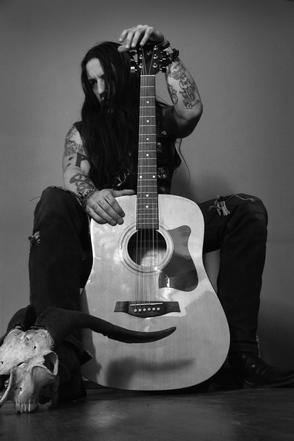
It's not exactly difficult to suss out Paul Waggener's particular musical affiliation. Long, flowing black hair. Check. Torn and frayed black jeans. Check. Skull patches: Check. Full-sleeve runic tattoo's. Double check. So yeah, he's into metal. Or, as he puts it when we sit down over coffee and beer at the White Hart, "heavy, heavy metal," with a distinct emphasis on heavy.
    But there's more than meets the eye with Waggener, whose extreme metal trio Hunter's Ground are playing February 17th at the Coffin House in Roanoke and are gearing up to self-release a six-track CD titled No God But the Wild. Put an acoustic guitar in his hands, and you'll quickly discover that his affinity for outlaws extends well beyond Pantera and Motörhead, back to a cadre of characters who, in their day, infused classic country music with a real element of danger, from Hank Williams and Johnny Cash, to Merle Haggard, Waylon Jennings, and one-time death-row inmate David Allan Coe. Indeed, he'll be delivering a heavy dose of Hank Sr. and the the Man in Black, as well as his own similarly styled songs and a few choice countrified metal numbers, when he plays solo this Friday, February 10, at Rivermont Pizza.
    Waggener was born and raised in Cheyenne, Wyoming, home to "Frontier Days," the largest rodeo in the world, and a mecca for country artists of all persuasions.  "All of the biggest country acts would show up for Frontier Days," Waggener recalls. "The town would double in size. Otherwise, it's 50 thousand people, it's flat, it's depressing, and all there is to do is drink, do drugs, and play music, which is what I did until I left."
    By the time Waggener departed Cheyenne for Lynchburg six years ago, he'd already gravitated toward the more intense fringes of the metal spectrum. And, while thrash-and-bang remains a primary passion, he's since discovered a parallel, and equally primal fondness for classic country. Just don't confuse the roots music in Waggener's songbook with the kinder, gentler, commercial fare Nashville's Music Row has been pumping out for the past few decades. Waggener views that brand of country with the same scorn those ranch hands in the Pace Picante ad have for the poor fella who gets his salsa from New York City. "It's mostly just guys from California with fake Southern accents," Waggener says with obvious contempt. "And, they're singing about stuff they've never seen or done."
   
Q: So, is the headline here "Anarchist metal dude plays country music"?
    That's pretty close. When I was a kid, we used to listen to all kinds of country music. Then, as I got older, I wanted something more extreme, so I started playing really, really heavy metal. And then you start to realize that a lot of the themes are pretty much the same in black metal and country — it's all outlaw stuff, and it's all really grim, really dark. It's about death and murder… And about relationships gone horribly horribly wrong, usually ending in murder. Hank Williams and Johnny Cash are two perfect examples of that, and those are the two guys I cover the most because of the content of the songs. Hank Sr. is by far my favorite, because it just doesn't get any grimmer than that. Even my originals tend to sound a lot like Hank Sr. I mean, with country, it's like why try to reinvent the wheel. It's already been done as well as it's ever going to be done. So I try to make my originals sound as authentic as possible. A lot of those classic songs draw on a lifestyle that I've completely lived and that I'm intimately familiar with. So it's easy to draw on my own experiences when I'm writing songs.

Q: What are some of your songs, and what kind of experiences are you drawing on?
    "Black Magic and Moonshine" is one of my new ones. And I've got one called "Sorry To Let You Down." You know, real upbeat themes. It's the same topics and subject matter as the classic outlaw guys. I just put my own personal twist on the lyrics. Some of my songs have heavy devilry and occult overtones. But it's all done in the that old-school country music fashion. And, I have a song about meth, because that was big around where I grew up in Cheyenne. I mean, I watched people completely ruin their lives on meth. Just growing up there and seeing a lot of crazy, crazy situations…that's where a lot of my writing and music comes from. It's pure country gold. People may not pick up on it because what they hear is this really twangy old-school kind of country. It's just got lyrics that shouldn't be in there because you could never have gotten away with that back when Hank Sr. was alive.

Q: Hank's grandson, Hank III, does straight county and metal live and he's also done albums that are half and half. Have you ever considered doing something along those lines?

    The problem is that the places that I play the country stuff, you really can't do metal. And at the places the metal band plays, the kids don't really want to hear country music. But I think Hank III really has opened up a lot of metal kids to country. So I am going to record a five-track country demo and then a full-length that I want to call "Apocalypse County and Armageddon Blues." It's going to be ambient reverb-soaked country with big doomy electric guitars. I want it to be different and little bit original. But the great thing about that real classic kind of country music is there's a venue for it everywhere. I can walk into just about any bar in any city, set up and play a two hour set for $200. I'm going to try to do a lot of that this summer — just set up a mini tour circuit for myself. I'd love to be a point where I can just play like one show a week... and not have to have a day job.
http://www2.the-burg.com/entertainment/2012/feb/08/country-mettle-lynchburgs-paul-waggener-ar-1673278/

Wednesday, February 8, 2012

THE GRAMMYS

Adele, Bon Iver, and Jay-Z Get Their Night at the Grammys
by Matt Ashare The Burg, February 8
Can Justin Vernon as Bon Iver be this year's Arcade Fire?
Once upon a time, there may have actually been a certain logic to the Grammys. Back when the record business was fairly well centralized, radio was the dominant medium for song consumption, and a defined notion of what constituted the pop mainstream existed, it presented an opportunity for the organization that runs the awards — the National Academy of Recording Arts and Sciences (NARAS) — to put its best face, or faces, forward. And, as with the Oscars, there was a measure of predictability when it came to who got the big nominations. But those days are long past. And nothing in recent memory illustrated that more vividly than the closing moments of last year's 53rd annual Grammy Awards show, when an unconventional indie-rock band from Toronto, the Arcade Fire, beat out multi-platinum rapper Eminem, pop princess Katy Perry, and a pair of Ladies — Antebellum and Gaga — for Album of the Year, on a night when tween sensation Justin Bieber was mercifully upset by jazz artist Esperanza Spalding in the Best New Artist category.
         So, yes, in spite of expected multiple wins by marquee stars (Eminem, Jay-Z, John Legend, and the above mentioned Ladies), as well as a few respectful nods in the direction of legacy artists (Paul McCartney and Neil Young), it was something of a watershed moment for an institution that hasn't always had a particularly good reputation for keeping up with the times. After all, the Grammys were famously slow on the uptake with hip-hop. And NARAS has endured some rather shameful moments in the past couple decades: a depleted Jethro Tull beating out Metallica for Best Hard Rock/Metal honors in 1989; Nirvana's "Smells Like Teen Spirit" losing to professor Eric Clapton's MTV unplugged recording of "Layla" for Best Rock Song in ‘92; and Steely Dan's Two Against Nature prevailing over Radiohead's OK Computer and Eminem's admittedly controversial The Marshall Mathers LP in 2000.
         All of which has made handicapping the 54th Grammys, which air this Sunday night on CBS, something of a crap shoot. Will the Arcade Fire win of 2011 truly mark the start of a trend? Or will NARAS voters, cowed by angry Bieberheads, take a more measured, conservative approach when they cast their ballots? On the surface, at least, the list of nominees suggests it could go either way.
         Not surprisingly, rap superstar Kanye West goes into the night as an odds-on favorite with seven nominations. Then again, Eminem had a full ten last year, and only walked away with two. It should also be noted, with appropriate bemusement, that Kanye's in the paradoxical position of being up against himself for Best Rap Album, with his My Beautiful Dark Twisted Fantasy sparring with his Jay-Z collab Watch the Throne for Rap Album of the Year. (Unless I've got the math wrong, that means the most he can win is six.) Of course, Kanye's got a bit of a checkered past when it comes to awards shows (see: Taylor Swift), and, for all of his obvious talent and industry power, he is not quite the kind of role model NARAS tends to prefer. So don't be surprised if, like Eminem, he only comes away with a pair of victories.
         If there is anything close to a sure bet this year, it's gotta be British soulstress Adele, a critic's darling with a clean record, six nominations, and the right profile to be a Grammy poster girl. Her 21 may very well leave Lady Gaga high and dry in the Album of the Year category for the second year running. But thanks to some major changes in some major categories, Adele's going to face stiff competition not just from Lady Gaga, but also from seasoned songwriter-turned-pop star Bruno Mars in a category like Best Pop Solo Performance because this year NARAS has done away with separate slates for male and female artists. And Mars, along with the alt-rocking Foo Fighters, also has six nominations.
         But the most intriguing prospect for the kind shock and awe the Arcade Fire brought to last year's show comes by way of another indie upstart, the artist known as Bon Iver (a/k/a Justin Vernon). Vernon is in the running for four Grammys — Best Song, Best Record, Best New Artist, and Best Alternative Album. It's a long shot, but if Adele and Mars split the pop vote for Best Song, Bon Iver's "Holocene" could come out on top. And since Vernon wrote "Holocene" himself, the same could happen in the Best Record category. He's got the curvaceous Nicki Minaj to contend with if he's to take Best New Artist. And he's up against Radiohead's King of Limbs for Best Alternative Album, although Radiohead have got other opportunities (Best Rock Performance and Best Rock Song).
         Which leads me to some of the more perplexing aspects of this year's Grammy nominations — yes, more perplexing than the distinction between Best Record and Best Album. What makes Radiohead more "alternative" than Wilco, whose The Whole Love is stuck in Best Rock Album with Jeff Beck's Rock 'n' Roll Party Honoring Les Paul (seriously?), as well as discs by Foo Fighters and the Red Hot Chili Peppers? If Beck's disc wins that one, it may amount to another Jethro Tull oops. It's also unfortunate that the Black Keys, who released the best album of their career last year, have to compete with a collaboration between the legendary Tony Bennett and the late Amy Winehouse in Best Pop Duo/Performance. I mean, really, do the Black Keys as a pop duo? And, while I had been hoping that the Decemberists might enjoy a much deserved Arcade Fire moment this year, that's just not the way it's looking to pan out. They got some props — Best Rock Performance and Best Rock Song for "Down By the Water." And maybe they'll best Coldplay, Foo Fighters, and Radiohead in one of the two. But, as Sunday approaches, I beginning to think NARAS could do worse than asking the Arcade Fire back for a reprise of last year's closing credits.